
The ROI of Digital Signage for Cannabis Dispensaries
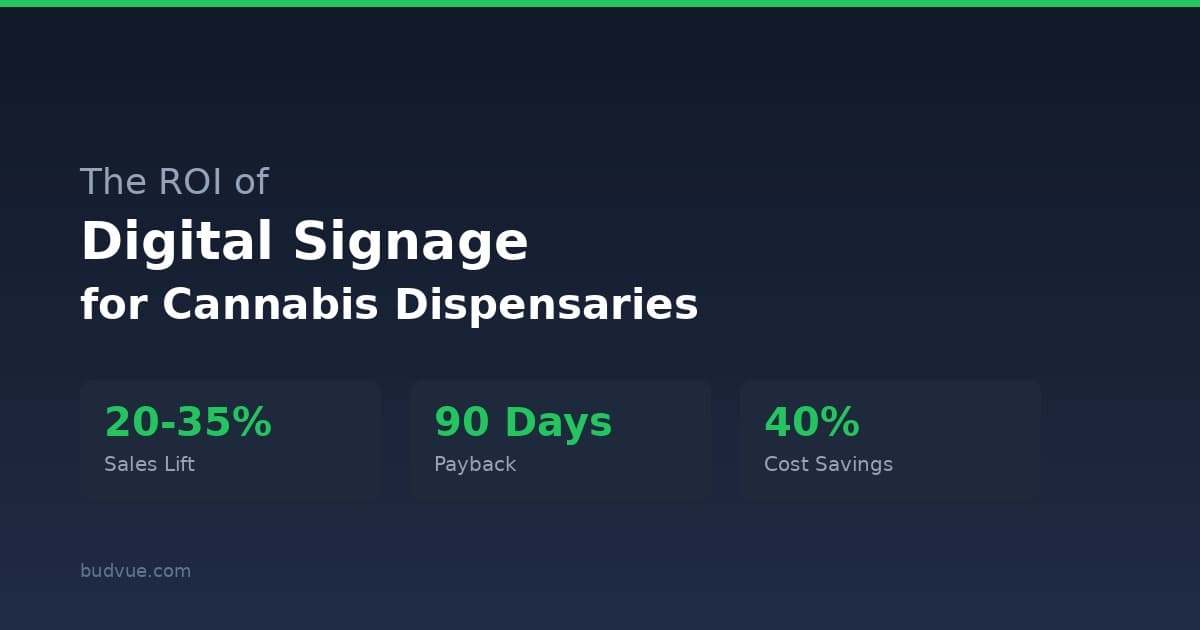
Your menu boards are the most valuable real estate in your dispensary. Every customer sees them, every visit. The question isn't whether digital signage works — it's how much revenue you're leaving on the table without it.
The Hidden Cost of Static Menus
Paper and whiteboard menus seem cheap until you add up what they actually cost. Staff spend time manually updating prices, crossing out sold-out items, and reprinting sheets every time your inventory changes. Meanwhile, customers stare at outdated information and miss products that could have caught their eye.
The real cost isn't the paper — it's the missed sales. A static menu can't highlight a new arrival, flag a limited-time price drop, or remove a product the moment it sells out. Every outdated line item is a friction point between your customer and a purchase.
Retailers who switch to digital signage report reducing print and labor costs by up to 40%, while eliminating pricing errors almost entirely. That alone often justifies the investment within the first year.
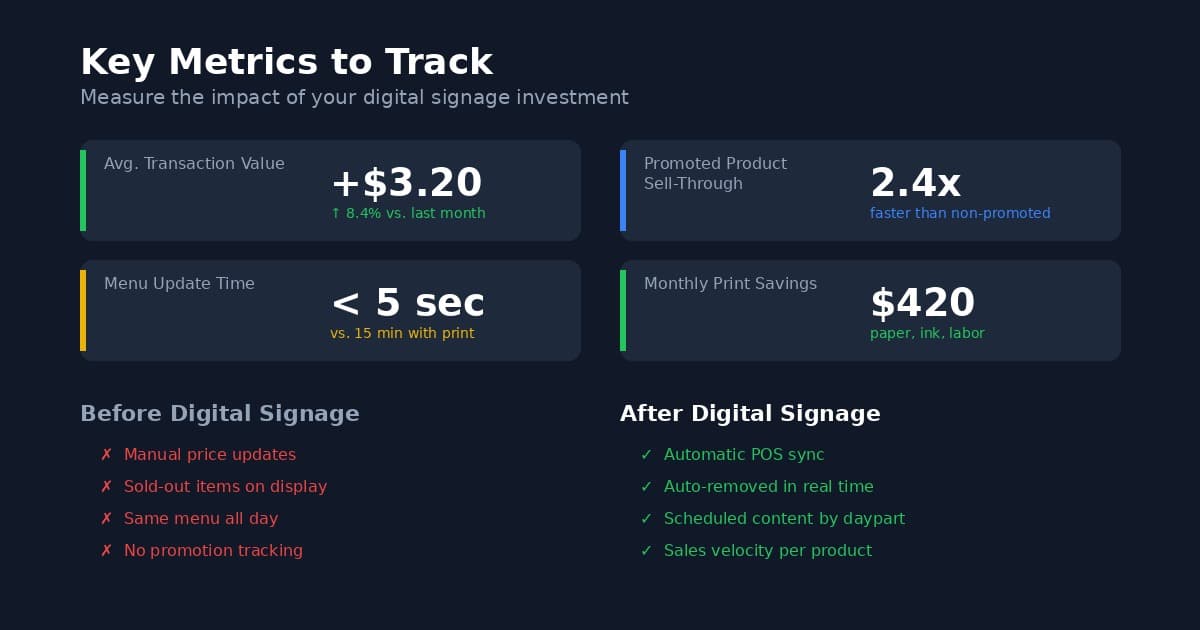
Key metrics to track: transaction value, sell-through rate, update speed, and print savings
Sales Lift: What the Numbers Say
Digital signage doesn't just look better — it sells more. Industry research consistently shows that dynamic in-store displays drive measurable revenue increases.
Retailers using digital signage see a 20–35% increase in sales of promoted products. That lift comes from three places: better visibility for high-margin items, real-time promotion of time-sensitive deals, and impulse purchases triggered by eye-catching content. Research suggests that nearly 1 in 5 shoppers make an unplanned purchase after seeing a digital display.
For dispensaries specifically, the impact compounds. Cannabis menus are complex — dozens of SKUs across flower, edibles, concentrates, and accessories. A digital menu that dynamically highlights what matters (new strains, staff picks, items on sale) cuts through the noise in a way that printed lists never can.
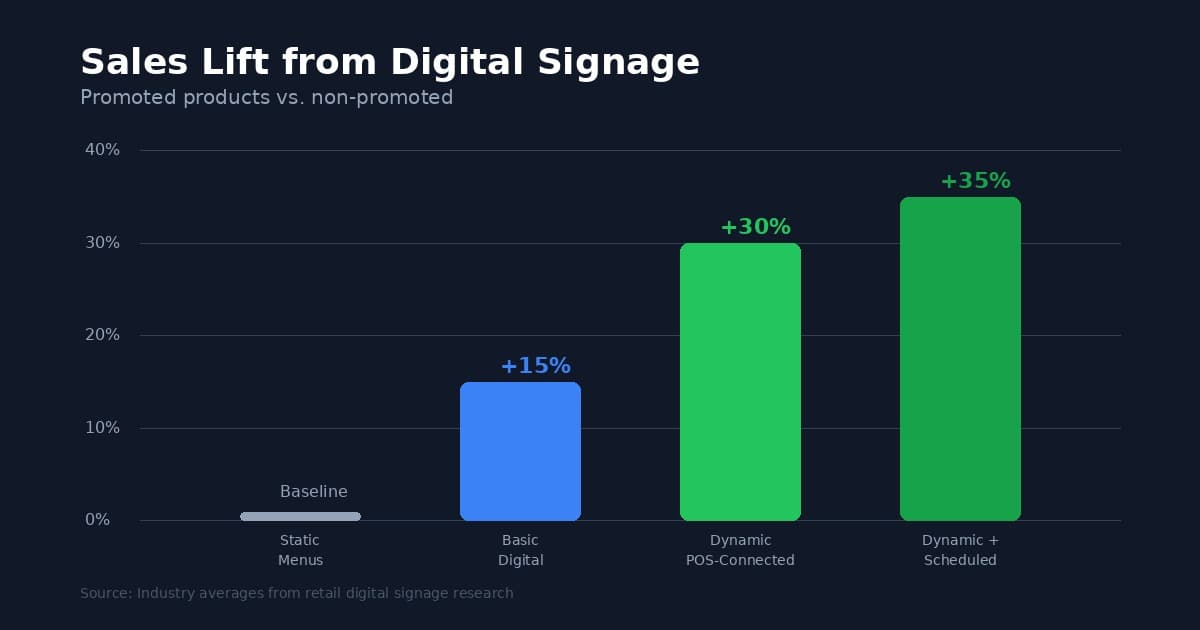
Sales lift comparison: static menus vs. basic digital vs. dynamic POS-connected vs. dynamic with scheduling
Upselling Without the Hard Sell
One of the strongest ROI drivers is something customers barely notice: strategic product placement on screen.
When your Promo TV highlights a premium concentrate next to an entry-level option, or shows a new edible alongside a best-selling flower, customers naturally explore higher-value products. This isn't aggressive upselling — it's informed decision-making. Retailers report a 22% higher upsell success rate when using dynamic, visually rich displays compared to static alternatives.
Digital signage also extends your budtenders' reach. During peak hours, when staff can't spend five minutes with every customer, your screens keep selling. They educate, recommend, and showcase — all without adding headcount.
Measuring What Matters
ROI isn't just a feeling. The dispensaries that get the most from their signage are the ones that track specific metrics before and after implementation.
Average transaction value is the first number to watch. Compare your basket size in the weeks before and after launching digital menus. Even a $2–3 increase per transaction adds up fast across hundreds of daily customers.
Sell-through rate on promoted products tells you whether your screens are actually moving the items you feature. If you tag a product as a Staff Pick and its sales velocity jumps, your signage is working. Budvue's Product Insights dashboard tracks sales velocity — units sold divided by days in stock — so you can see exactly which promotions are pulling their weight.
Time-to-update matters too. How long does it take to change a price, launch a flash sale, or pull a sold-out product from your boards? With a POS-connected digital system, the answer is seconds. That speed translates directly into fewer missed sales and fewer customer complaints about inaccurate pricing.
The Payback Math
Let's make this concrete. A single-location dispensary running four screens might invest $2,000–5,000 in hardware and $150–300/month in software. Here's what the return looks like:
If your dispensary processes 200 transactions per day and digital signage increases your average transaction value by just $3, that's an additional $600 per day — roughly $18,000 per month in incremental revenue. Even at modest margins, the hardware pays for itself within the first month or two.
Factor in the operational savings — no more reprinting, no more manual corrections — and most dispensaries see a full ROI within 90 days.
The retailers who see the highest returns are the ones who go beyond "set it and forget it" — rotating content, featuring seasonal promotions, and using data to double down on what's working.
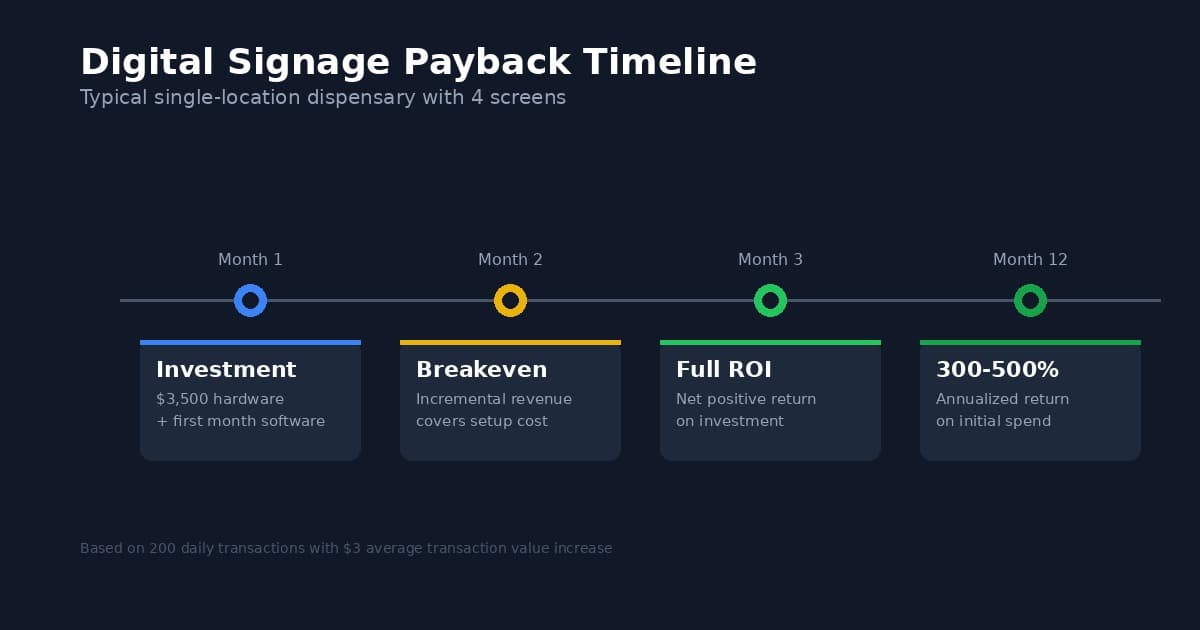
Digital signage payback timeline: investment to 300-500% annual return
From Passive Display to Active Sales Engine
The difference between a TV on the wall and a revenue-driving system comes down to how you use it.
Tag and feature products strategically. Use Staff Picks to spotlight items your team believes in. Use your Slow Movers data to identify products that need a push and give them screen time. When a product sells out, it should disappear from your display automatically — no manual intervention, no customer disappointment.
Schedule content around your business rhythm. Weekend promotions can go live Friday at open and turn off Sunday at close without anyone touching a screen. A lunch-hour deal can run from 11 AM to 2 PM every weekday. Pre-scheduling means your signage is always relevant and your team isn't scrambling to make last-minute changes.
Use your Content Library. Instead of designing promotions from scratch, start with proven templates that pull live product data from your POS. Tag the products you want to feature, and your display updates with real inventory, real pricing, and real availability.
The Bottom Line
Digital signage isn't a cost center — it's one of the highest-returning investments a dispensary can make. The data is clear: higher basket sizes, faster sell-through on promoted products, lower operational costs, and a better customer experience.
The dispensaries that invest in their in-store screens now are building a measurable advantage over competitors still taping printed menus to the wall. If you're ready to see what your screens could be doing for your bottom line, book a demo with Budvue and we'll show you.